
Australians are sending a clear message: the energy market should be fairer, and loyalty shouldn’t cost more.
For years, the Australian energy market has operated under an unspoken rule: if you stay with the same provider, you pay more. This so‑called “loyalty tax” has meant long‑term customers are often charged hundreds of dollars more, while new customers receive the best deals for the exact same service.
New national research, commissioned by Energy Consumers Australia, shows Australians overwhelmingly view this practice as unfair. It also reveals strong support for shifting responsibility onto energy providers to ensure people are on suitable, good‑value plans.
These findings reinforce the need for a duty to consumers in the energy market (a consumer duty), which Energy Ministers have agreed to further consult on in 2026.
Loyalty shouldn’t be penalised
The Australian Competition and Consumer Commission (ACCC) has found evidence of a “loyalty tax”, with customers on plans older than two years paying, on average, $317 more per year than those on newer offers.
For many households, regularly switching providers is time‑consuming, confusing and stressful. Energy plans are complex and comparisons can be difficult, leaving people overwhelmed and disengaged from the system.
Our previous research shows that one of the main reasons households experiencing, or vulnerable to, energy hardship did not recently review their energy plan was that they “wouldn’t know where to start.” In contrast, the most common reason given by households (not reporting hardship indicators) for not switching was that they were “happy with their current plan.”
This demonstrates our current system, which relies on consumers shopping around, can disadvantage those least equipped to navigate it, leaving them more exposed to higher-cost plans.
Our current system, which relies on consumers shopping around, can disadvantage those least equipped to navigate it, leaving them more exposed to higher-cost plans.
The “loyalty tax” fails the fairness test
When Australians were asked how fair it is for new customers to be offered a cheaper price than long-term customers for the exact same energy plan, the results were striking:
- 75% said it is unfair from the perspective of a loyal customer
- 67% said it is unfair even from the perspective of a new customer benefiting from the lower price
Figure 1: How current and new customers view the fairness of cheaper energy plans for new customers
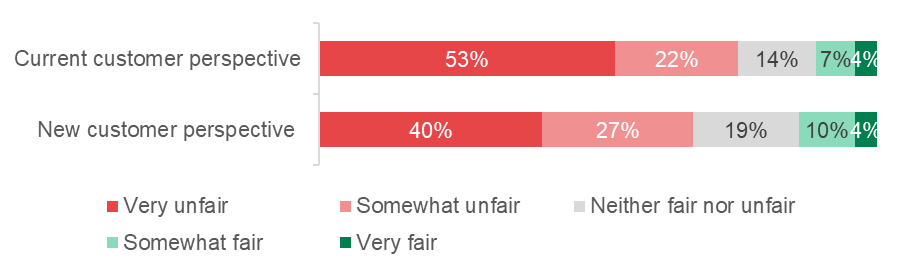
Source: SEC Newgate on behalf of Energy Consumers Australia, February 2026.
In other words, even when Australians imagine themselves getting the better deal, most still believe the system itself is unfair.
In an essential service like energy, a market that requires consumers to constantly switch plans or providers to avoid paying more isn't a sign of healthy competition; it’s a sign the system isn’t working as it should. Consumers expect energy retailers to treat long-term customers fairly, rather than charging them more to cross-subsidise discounted offers for new customers.
Australians want providers to take responsibility
We also asked Australians who should be responsible for ensuring customers are on a suitable plan that offers good value.
believe energy providers should be required by law to ensure their customers are on an energy plan that is suitable for them and offers good value
believe it should primarily be the customer’s responsibility
Consumers don't see fairness as something that depends solely on their ability to navigate the market. They expect the system to deliver fair outcomes by design.
This expectation aligns closely with Energy Consumers Australia’s work exploring the introduction of a consumer duty for Australia’s energy market, a reform that would shift responsibility from consumers to providers.
Time to shift the model: From responsible consumer to responsible provider
For years, energy policy has largely relied on expectations of high levels of consumer engagement, encouraging people to search for better plans and switch regularly to avoid overpaying. You may have heard, or even given, this advice to consumers yourself: if you think you’re paying too much, shop around.
This approach assumes everyone has the time, confidence and capacity to actively participate in the energy market. Evidence suggests that's not the case.
As a way forward, Energy Consumers Australia is exploring a new approach to regulation that places the responsibility on retailers to deliver good outcomes through an overarching consumer duty.
This outcomes-based framework would ensure all Australians, regardless of how often they shop around, benefit from fair pricing in an essential service.
A fairer energy market is possible, and Australians are ready for it.