
New modelling (PDF, 319.44KB) highlights risks to South Australian consumers as the gas network transitions – as well as the significant savings consumers can make through electrification.
Gas use in homes is declining as Australia moves toward its net zero emissions targets. Our research shows South Australian households are already signalling this shift: 28% of South Australians plan to cancel their mains gas connection within the next 10 years.
This report (PDF, 319.44KB), commissioned with Dynamic Analysis, models the long-term outlook for Australian Gas Network (AGN)’s residential customers in South Australia and examines what the next five-year decision could mean for household bills.
Key findings
- Gas bills are projected to rise sharply for South Australian households
- Accelerated depreciation would bring costs forward, without changing the outcome
- Electrification is the lowest cost option for South Australians
Gas bills are projected to rise sharply
A typical household in South Australia uses around 13.5 GJ of gas each year and is billed around $614 in gas network costs. Fast forward ten years, and that same usage is projected to cost $1,008 - or about 64% more than it costs today - and more than $2,200 by 2050.
This is because gas pipelines and infrastructure were built to serve many households and small businesses over decades. And as more households electrify, those infrastructure costs will be recovered from fewer customers.
Accelerated depreciation brings costs forward, but doesn’t change the outcome
Accelerated depreciation has been proposed by Australian Gas Networks SA (AGN), to bring forward around $80 million of asset recovery, so customers pay more now, while there are more on the gas network.
But our modelling shows (PDF, 319.44KB) that if South Australian households were to pay more now, it would make very little difference to the overall financial risk facing the network, and the amount consumers have to pay networks in the future.
As an example, a typical household would pay around $170 more over the next five years under AGN’s proposed approach, while the remaining network cost to be recovered would decrease by only about 2.8%.
While rule changes are being considered, a broader policy question for governments needs to be addressed: how can we ensure consumers aren’t left paying an unfair share as the gas network transitions?
Electrification is the lowest-cost option for South Australian households
Electrification is already recognised as one of the most efficient and cost-effective ways to reduce emissions. This is particularly relevant in South Australia, which has set a target to achieve 100 per cent net renewable electricity generation by the end of 2027.
As the electricity system becomes cleaner, switching from gas to electric appliances will allow households to benefit directly from that transition, especially when rising gas network costs are factored in.
A typical South Australian household that switches to electricity could save roughly $500 per year if it switches in 2026, and around $750 by 2035. These savings would increase over time, as gas bills become more expensive. While these figures don’t account for upfront appliance or disconnection costs, if appliances are replaced at the end of their life, choosing efficient electric alternatives can lock in long term savings.
of South Australians plan to cancel their mains gas connection within the next 10 years
increase in network costs for a typical South Australian household within a decade

Electrification can also save money for all electricity consumers, beyond just those who are switching from gas. If household gas customers electrify over time, the modelling shows:
- Existing South Australian electricity customers could save more than $150 million over 10 years
- A typical 5,000kWH household would save around $140-$220 over a decade, depending on tariff type
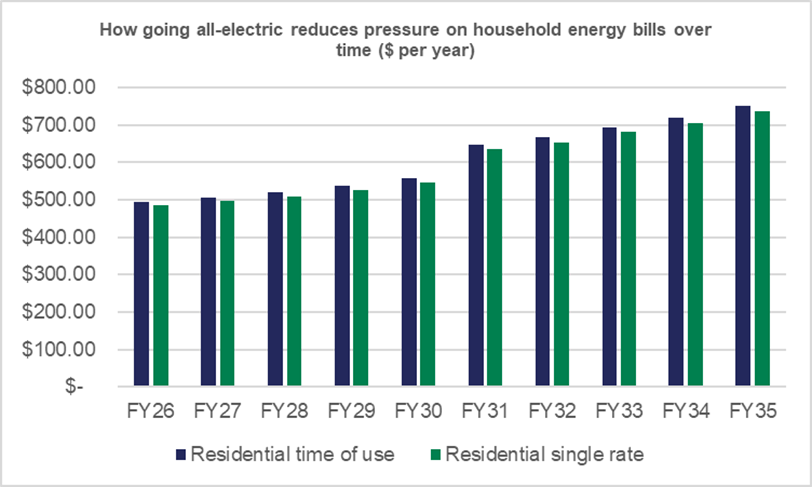
Source: SA Residential Gas Customers - Long-term analysis - Report to ECA (Dynamic Analysis)
These savings occur because higher electricity demand allows the network to operate more efficiently. The cost to maintain poles and wires does not rise in proportion to energy use, so when more households use electricity, those (largely fixed) costs are spread across more energy and more customers. That reduces the amount each household needs to pay.
Protecting South Australians in the transition away from gas
South Australia has shown it can lead Australia’s clean energy transition. It has one of the highest rates of rooftop solar in the world, the most consumer energy resources per customer in the National Electricity Market, and a target to reach 100 per cent net renewable electricity generation by 2027.
The next step is to ensure the shift away from gas is managed fairly. This means planning for a declining gas network in a way that protects households from rising costs, shares risks more equitably, and supports consumers to electrify when appliances reach the end of their life.
Our modelling shows what's at stake. Electrification can ease pressure on household energy bills and deliver system-wide savings. But without careful planning, remaining gas customers could face escalating costs as the gas network contracts. How the transition from gas to electricity is managed will determine whether South Australians experience electrification benefits, or face avoidable financial pressure as gas use declines.
FAQs
Accelerated depreciation is the practice whereby the Australian Energy Regulator has allowed gas distribution networks to require consumers today to pay more for the gas distribution network, to reduce the costs network investors might face later.
A tariff (in the context of energy) is a pricing structure that determines how customers are charged. An example of a type of electricity tariff is a 'time-of-use' tariff, where a customer is charged a different price for electricity based on when they use electricity.


