When the federal government's new mandated plan with three hours of free electricity comes into effect in July, it’s a fair assumption that Australians will flock to the new offer.
Free electricity — what’s not to like?
But our analysis shows that some consumers are not able to take full advantage of it — and some may even be worse off if they switch to the offer. It is critical that governments and retailers clearly communicate the advantages and disadvantages of these plans.
What is the Solar Sharer Offer (SSO)?
The new Solar Sharer Offer (SSO) offers customers up to 24kWh of free electricity in a three hour period in the middle of the day. From 1 July 2026, retailers with more than 1,000 customers in New South Wales, South-East Queensland and South Australia must offer it. The Victorian Government has separately announced a similar scheme, called Midday Power Saver, available from 1 October 2026.
The SSO sends an important message to households: we often have abundant, cheap, renewable energy in the middle of the day, making it the best time to increase consumption. Appliance use that can be shifted away from the evening can reduce pressure on the grid during its busiest periods, lowering wholesale market costs in a way that benefits all.
Not many Australians are aware of the Solar Sharer Offer
When Energy Consumers Australia surveyed Australians in May 2026, less than 3 in 10 were aware of the Solar Sharer Offer. Awareness was highest for Victorians and lowest for Western Australians (which is unsurprising, given the offer is unavailable in WA).
Awareness of Solar Sharer Offer by location
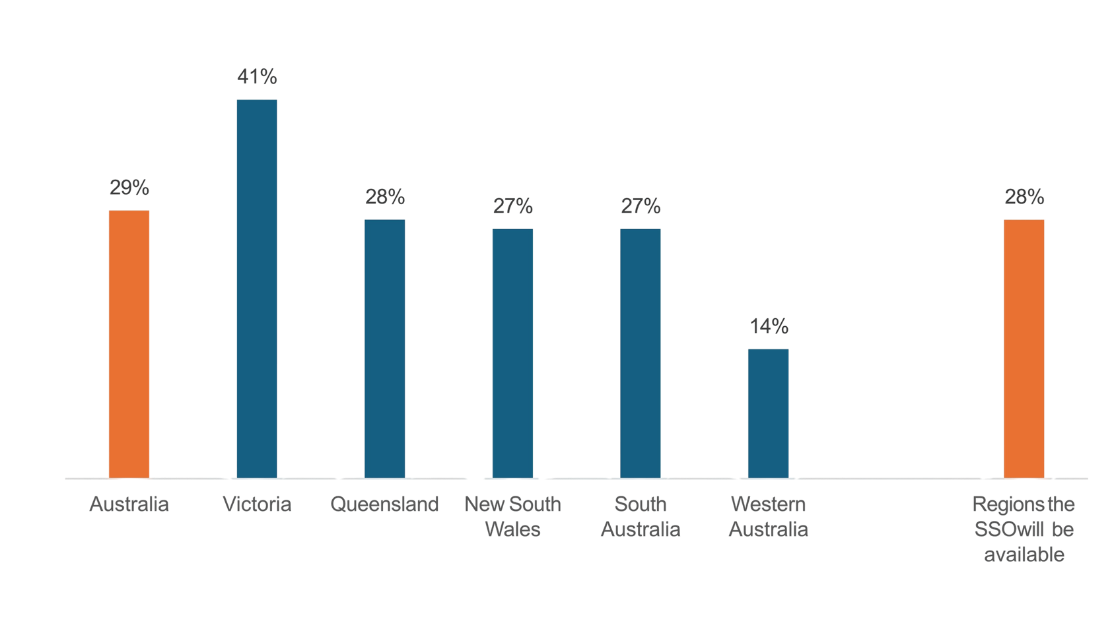
Source: SEC Newgate on behalf of Energy Consumers Australia, May 2026. Question: Earlier this year, the Federal Government announced a new initiative called the Solar Sharer Offer (SSO). Under the SSO, energy retailers will offer households with smart meters 3 hours of free electricity. It will be scheduled for the middle of the day when solar generation is at its peak. Before today, were you aware or not aware of the Solar Sharer Offer (SSO)? (n=1,210).
Many households say they would be interested in the SSO
While awareness of the SSO is low, many said they would be interested in signing up if it were available to them. Nearly half (48%) of the people we surveyed have some interest in joining the SSO.
Given interest is higher than awareness, it suggests that if awareness were higher, more people would be interested in it. However, while Victorians had the highest awareness, it did not translate to a higher level of interest in the offer.
Likelihood of opting into the Solar Sharer Offer if it was available to them
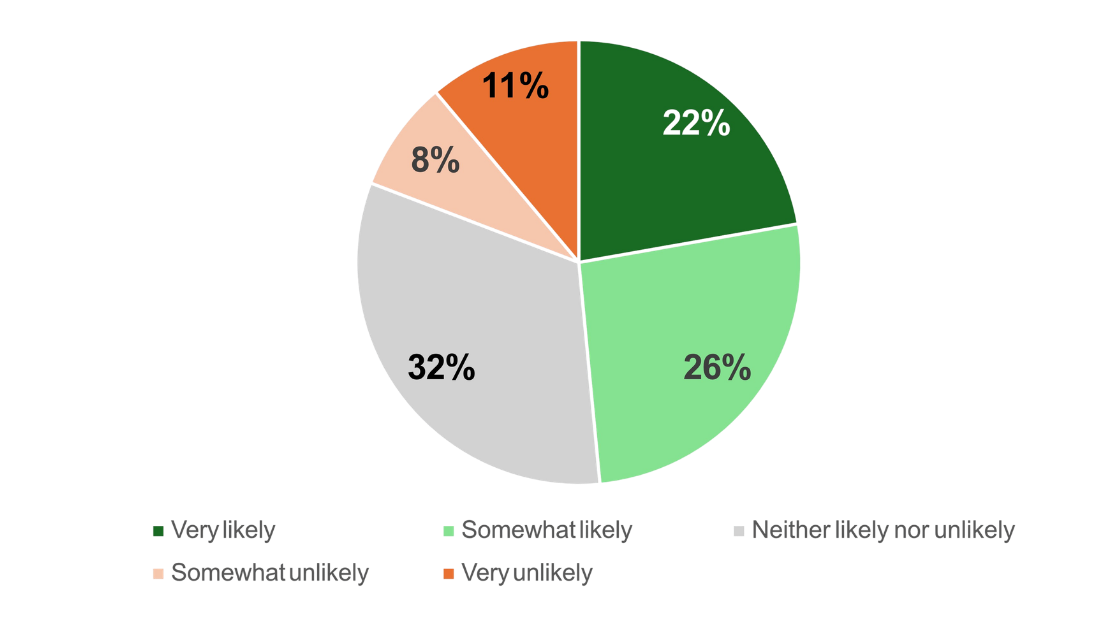
Source: SEC Newgate on behalf of Energy Consumers Australia, May 2026.Question: If it was available in your area, how likely or unlikely would your household be to opt-in to the Solar Sharer Offer? (n=1,210).
While the SSO regulations are new, many retailers already offer free electricity in the middle of the day. For example OvoEnergy has been providing a three-hour free consumption plan since 2024; Globird offers a four-hour free energy plan; and Origin offers customers an hour of free energy.
As such, many households who are interested in such plans may already be on one.
But when we surveyed our participants, we did not present participants with actual SSO plans and only provided a high-level explanation. Most importantly, we did not explain a critical detail, which is that while the SSO features a free power period in the middle of the day, retail rates outside this window are higher. This means that enthusiasm for the SSO might reduce once households carefully compare their current offer with the SSO.
The chart below shows SSO prices for households living in the Ausgrid network, against the Australian Energy Regulators’s default time of use (TOU) and flat rate plans. While the SSO might be free during the middle of the day, this lack of revenue is offset by higher rates in other periods.
Default offers in the Ausgrid distribution zone in 2026-17 (cents)
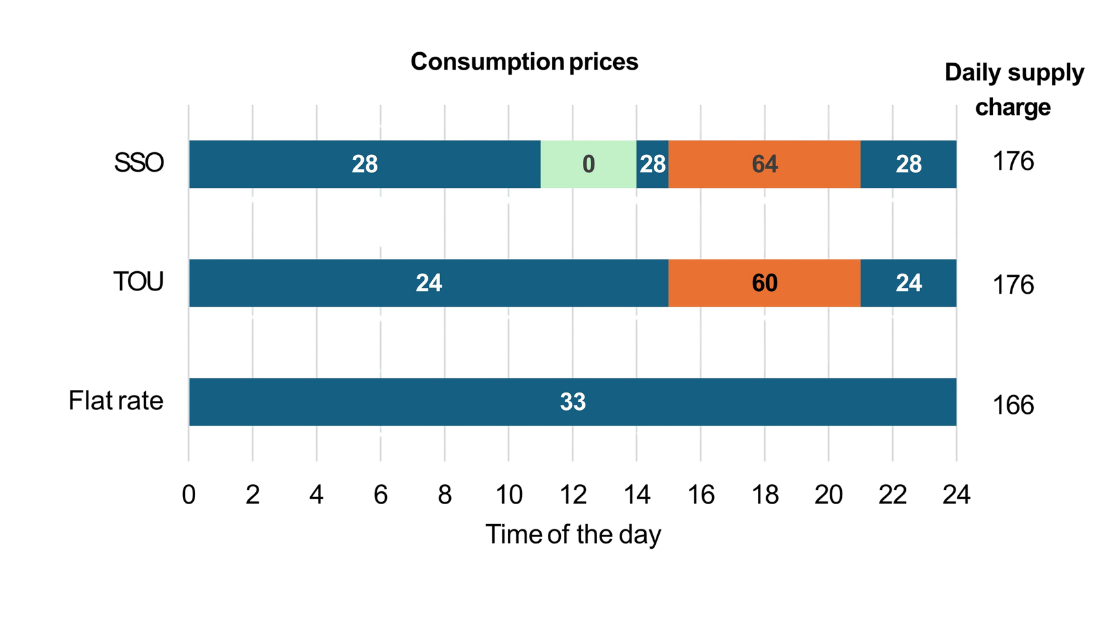
Source: ECA analysis of AER, 2026-27 Default Market Offer Final Decision, 2026.
As an offer regulated by government and set by the Australian Energy Regulator, it is designed to be inherently risk averse and is not necessarily designed to attract customers. As such, the SSO is likely to be much higher priced than competitive offers already in the market. For perspective, Origin’s Variable Go plan offers households in the Ausgrid network a flat 34-cent consumption charge, alongside a supply charge of $0.89 per day.
The SSO may not be attractive for many households
This means that the design of the SSO forces consumers to make a complex trade-off between free energy in the day and higher prices in all other periods.
As an illustration, imagine a customer on the Ausgrid Variable Go Plan consuming 20kWh of electricity a day, on average. Currently, they would pay around $2,800 a year. Whether the SSO was better for them would depend on:
- a) how much energy use can happen in the free period, and
- (b) how much energy use would remain at peak times.
For example, if 30% of electricity could be consumed in the free period, with 40% during the 3 to 9pm peak window, they would be around $320 worse off on the SSO. But if 30% of electricity could be consumed in the free period, with 20% during the peak window, they would be around $210 better off.
Therefore, if households can materially increase or shift electricity use to the middle of the day, the SSO may indeed be good value.
However, for those that can’t shift consumption, they may be better off on a standard flat rate plan.
So while the SSO correctly identifies the societal benefits of increasing consumption in the middle of the day, governments and retailers need to clearly communicate these trade-offs. We don’t want to have people signing up to these plans assuming it will decrease their bills, when in fact it could do the opposite.
This article was originally published in The Energy.
FAQs
The Solar Sharer Offer (SSO) will offer customers up to 24kWh of free electricity in a three-hour period in the middle of the day.
From 1 July 2026, electricity customers in New South Wales, South-East Queensland and South Australia will be able to access it through their energy retailer (as long as their retailer has more than 1,000 customers).
For customers in Victoria, a similar scheme, the Midday Power Saver, will become available from 1 October 2026. Head to the Victorian Government's website for more information about this scheme.
Eligible households in Default Market Offer (DMO) areas (NSW, SA, SE QLD) will be able to opt in to the Solar Sharer Offer through their energy retailer (so long as that retailer has more than 1,000 customers) from 1 July 2026. Victorian households will be able to opt in to a similar scheme, Midday Power Saver, from 1 October 2026.
Signing up for the Solar Sharer Offer is optional. It's important that energy customers select the right offer for them. To find out more information about the offer, head to energy.gov.au or for information about available energy plans, head to Energy Made Easy.
The Solar Sharer Offer (SSO) will come into effect on 1 July 2026. Head to energy.gov.au for more information
Article by

Share this news


Subscribe to our newsletter
Join our community to access analysis on energy events, be the first to see our latest market research, receive invitations to stakeholder events, and help advance consumer needs.