Up to $1000 per year "left on the table" for households with solar and batteries
Australian households with solar and batteries could be missing out on significant savings from Virtual Power Plants, as energy companies struggle to earn the trust of consumers. A new report from Energy Consumers Australia shows why a consumer duty and fairer rewards are overdue.
The 'Why households adopt batteries and why many aren’t joining a Virtual Power Plant' report examines why uptake of this key technology is so low and calls for a range of recommendations including a consumer duty to establish consumer trust in energy companies.
"Virtual Power Plants could be a major part of our energy future, but we are not seeing strong uptake" says Ashley Bradshaw, acting General Manager, Advocacy and Policy, Energy Consumers Australia.
"This won’t happen unless energy companies establish trust and give people a clear value proposition. A consumer duty that gives consumers confidence that energy providers are required to use batteries in the consumers’ best interests is just one way we can give Australians more confidence to participate in a Virtual Power Plant. Significant savings and trust are on the line."
Virtual Power Plants coordinate solar and batteries from households to operate together like a single power station. They offer savings to households, support grid stability, reduce peak demand and offer more flexibility. Despite strong benefits to households, uptake is alarmingly low, with our research finding that only 4% to 10% of battery owners participate in a Virtual Power Plant.
A Virtual Power Plants explainer video is available for download and publication on request.
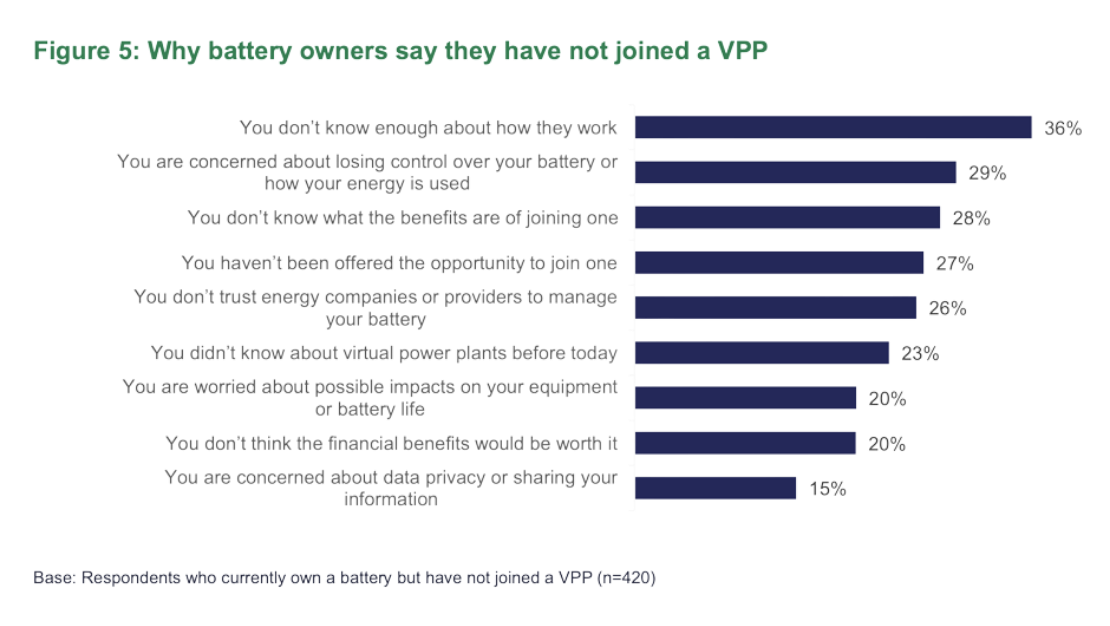
Energy Consumers Australia’s report finds a quarter of household battery owners who have not joined a Virtual Power Plant say they don’t trust energy companies to manage their battery and over one third say they don’t know enough about how Virtual Power Plants work.
"There’s a number of reasons why Australians have struggled to engage with Virtual Power Plants" says Mr Bradshaw.
"The ACCC estimates that households could be saving up to $1000 a year if they participated in a Virtual Power Plant, but those savings are being left on the table if Australians aren’t aware of, don’t trust or don’t understand what Virtual Power Plants do. Our research makes the path forward clear - establish genuine consumer trust in energy companies. Energy Ministers must progress an economy-wide consumer duty to ensure fairer outcomes for consumers and maximise the benefits of the solar and battery revolution."
Media contact: media@energyconsumersaustralia.com.au, 0492 849 846 (Forwarding number, cannot receive SMS)
About Energy Consumers Australia
Energy Consumers Australia is the independent, national voice for residential and small business energy consumers. We enable residential and small business energy consumers to have their voices heard.
Editor’s notes:
The research found that 64% of battery owners are interested in participating in a Virtual Power Plant. It also found that 80% of people researching or considering purchasing a battery are interested in participating in a Virtual Power Plant.
Find out more about what a consumer duty could look like: Exploring a consumer duty for Australia’s energy market
In July 2026, the ACCC found that households with solar and battery using a Virtual Power Plant had annual bills $762 to $1093 lower (57-63%) compared with households using electricity from the grid only. The ACCC also recommended the introduction of a consumer duty underpinned by supporting principles to ensure adequate safeguards for current and emerging energy services.